Hamlet’s Hit Points

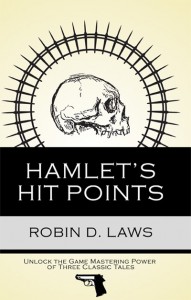
A couple months ago, I had the honor of proofreading Hamlet’s Hit Points, the new work by esteemed game designer Robin D. Laws. In the book, Robin discusses how stories work and codifies the aspects that you find over and over again, the pillars of storytelling. He also dissects three classic stories in very different genres (Dr. No, Casablanca, and the titular Shakespearean work) by putting his code into practice. And all of this is done with an eye toward tabletop gaming.

Gameplaywright, of The Bones and Things We Think About Games fame, released the book at GenCon and it quickly sold out. If you have an interest in stories, games, and especially stories in games, and you missed your chance to get it at GenCon, you can get the book now straight from the publisher.

I’m always looking for solid texts on story and this is a good one. That it’s by a designer I know and respect makes it that much better.

Posted in essays, rpg | Tagged , , , , | Leave a comment

The Haunted House, an Illustrated Tale

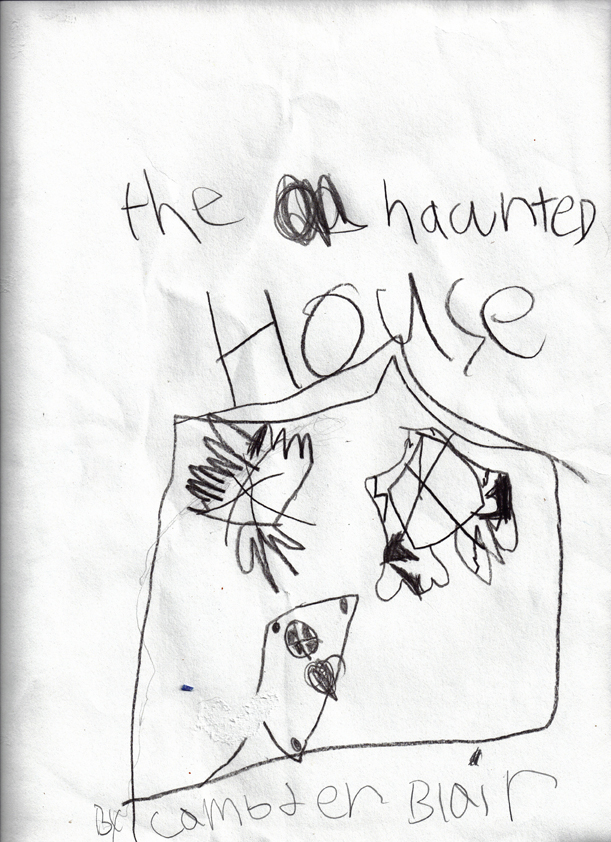
The following is based on a true story.

The Haunted House, by Cambden Blair

Continue reading

Posted in fiction | Tagged , | 2 Comments

The Three-Headed God

Over at his blog, Daniel M. Perez shares the stomach-twisting playtest premier of his first tabletop design, a reimagining of the popular roleplaying game Vampire.

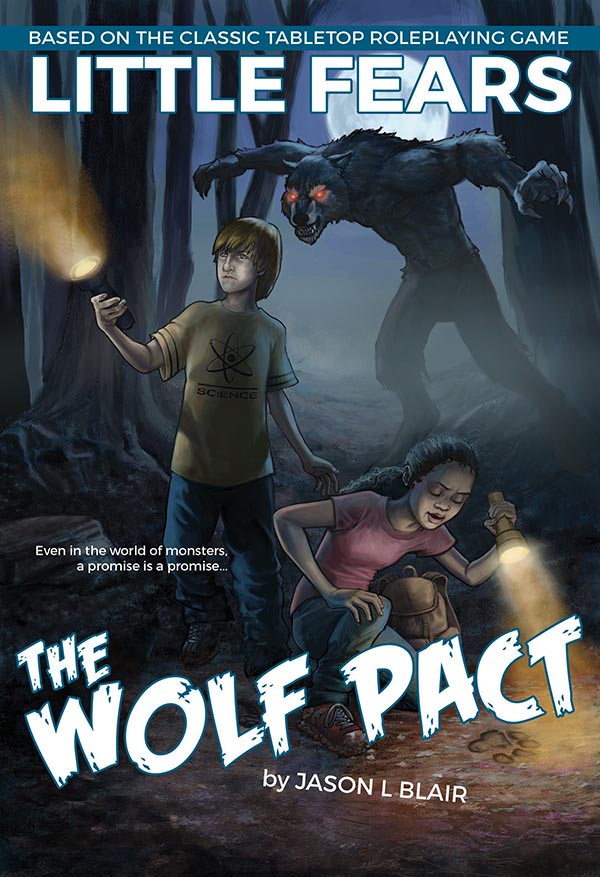
Daniel’s travails at running his first design reminded me of the terror I felt when running my first game, Little Fears, for folks outside my gaming group. In fact, when Little Fears made its print debut at Origins 2001, I didn’t run a single game of it at the con. I recruited my friend Greg Oliver to do the heavy lifting there. I spent my time at the booth where I was busy learning the ways of convention selling, The Pitch, and answering questions about this strange new game, and fielding a truly humbling industry and retailer response to the game.

Truth is, I’ve only ever been comfortable running one of my own designs, the brilliant-but-canceled Normal, Texas. Even then, the first public game was gut-wrenching (shaking from nerves, sweating a truly uncomfortable amount, laughing a little too long at every funny comment, taking too much time to explain the system) but I eventually found my rhythm demoing that game. I developed a short script that explained the mechanics quickly. I learned to always start the demo in media res. I set up the scenario and got to “Okay, what do you do?” in under a minute. I developed a handful of scenarios and characters I used over and over to the point that I could, throughout play, suggest a variety of actions for players if they were stuck. (Read as: I cribbed from previous sessions featuring that same character played by other people.) That became my demo paradigm. But Normal, Texas is a bit of an anomaly; I’ve never developed that same level of comfort with any other design of mine—no matter how much I’ve played the game.

I get requests to run Little Fears at conventions and I oblige where I can. But I’m not the best person for the job. I think that’s okay. Because designing and demoing are entirely different skill sets. Designing and selling are different skill sets as well. Yes, though closely related, demoing and selling are also different skill sets. Only a three-headed god would be great at all of them. But all are put to the test in the convention environment, moreso than anything else that went into the creation of the game.

In the tabletop world, you learn a lot of different skills, from editing to layout to print buying to conventioneering and only a few people truly excel at all of those. They’re crafts that, if you’re not a natural (and, man, who is), you need to study and nurture to really get good at them. When first starting out, you can only put your focus on so many of those things. If you’re a game maker, you focus on design which is the most important. You want a beautiful product, which will help move your game, so art direction and layout are important as well. If you want your book on shelves, learn your options for wholesale and retail representation.

That’s a lot to learn and that’s only half of it. Once you get a feel for all this, you start to learn your strengths and weaknesses in each field. The bold move is to learn it all. Dive right in; take on every responsibility as your own. It’s bold, yeah. It’s also dumb. That’s what I did and I don’t recommend it. Not at first, certainly, and maybe never. Since I was doing so much, I couldn’t devote the time necessary to truly excel at any one skill. My knowledge was broad, yes, but thin.

There’s no shame in handing off a design to someone else whose willing to demo your game. This goes for playtesting as well. Sure, you want the most direct and pointed feedback at that stage but you may not be the person who is best equipped to get that information.

You haven’t failed because someone else is better at selling your game than you are. There’s a reason the big companies have demo teams and salespeople. There’s a reason your favorite designer may not be running games at Gen Con or handling customers at the booth. It’s not (necessarily) because they’re aloof. They may just not be the best person for the job. Hey, they may be the worst person for the job. (Few things will turn off a potential sale faster than the overly-enthusiastic and tortuous hard sell that I’ve received from a fair number of designers.) You are probably not in a position to hire demo teams or sales reps but you probably have friends who can help out.

Along that same line, there are folks who are brilliant demo or sales people who aren’t great at design. And I’m not holding one above another here. As someone who has been in each position, those who are good at each skill are aces in my book.

I’ve been very fortunate in my career to have worked with top sales folk (calling out T.S. Luikart on this one) and demo people (looking at Caz Granberg here). They both (and others) have made this mid-level designer look good. To all my fellow designers who are also not three-headed gods, I hope you find good people as well (which may be the single best skill of them all).

Posted in essays | Tagged , , , , | 3 Comments

Back from the Big Show

I rolled home late Sunday night still riding the high from five glorious days spent catching up with old friends, making new ones, and playing some games. I came to GenCon for the sole purpose of seeing friends and kept that as my priority throughout the show. Still, I talked some business, landed a few gigs, and made some new connections, all of which is like piling cherries on top of a cherry-frosted cherry cake already dripping with cherry liqueur.

Little Fears Nightmare Edition sold out at 3:30 on Sunday (seems I brought just the right amount of copies) and, though I didn’t witness most of those sales, I was present at a few who received the new edition with a lot of enthusiasm. If you missed picking it up at the show, it’s available through the official site and select retailers in hard copy and through DriveThruRPG in PDF.

GenCon is a magical event. I’m renewed and reinvested in the hobby and industry that has been so good to me. After a long time away, it’s good to be back. Let’s see what the future brings.

Posted in rpg | Tagged , , | Leave a comment

GenCon on my Mind

I’m heading out to GenCon Indy soon, my first since 2006, and I’m quite excited to see a lot of friends I haven’t in that time and hopefully come away with a few more. I’m going as a civilian this year so don’t have much officially planned but I’m not hard to spot milling about the floor. (I’ll probably have a towel with me.)

For those interested, Little Fears Nightmare Edition will be on sale at Cubicle 7‘s booth (#315) and I’m sure I’ll be around there a fair bit.

I’ll also be at the Diana Jones Awards on Wednesday and most likely at the Ennies Awards ceremony on Friday.

On Sunday, I’ll be at Gameplaywright‘s signing ceremony for their all-about-dice anthology The Bones (to which I contributed an essay). That will be from 1p-2p at the Indie Press Revolution booth (#2339).

Outside of those, who knows! I’m focusing on fun and catching up this year. I’m open to ideas if there’s a gathering or function you wouldn’t mind me crashing. Find me on the floor, on Twitter, via phone or email.

To those going, I’ll see you there! To those not, I’ll see you when I get back (and maybe at a later show sometime).

Posted in news | Tagged , , , | Leave a comment

Character Collection: Dark•Matter (Alternity)

I was turned onto Alternity about this time last year. Though I forget the source of the initial spark, the fire caught quick and burned bright. I read everything I could on it, scouring Wikipedia, online reviews, and the excellent fan community website AlternityRPG.net. Something about the game hooked me and, through resources such as Noble Knight, gifts from very generous friends, and the occasional rare find at used book stores, I’ve managed to collect almost everything that was released for the line.

You could say I’ve become quite the fan. Unfortunately, I haven’t had a chance yet to play it. I haven’t even made a character. But I’m going to fix that last part right now.

A Bit about Alternity
Designed by Bill Slavicsek and Richard Baker, Alternity was TSR’s sci-fi cousin to its fantasy titan Dungeons & Dragons. Two books form the basis of the system, the Player’s Handbook and the Gamemaster Guide, with supplements rounding out the core concept and a handful of campaign settings that tort the system towards various ends.

Alternity is a generic system, as much as any system can be generic, and differentiates itself from its cousin in a couple notable ways. The first is a roll-under system, which has a penalty- and bonus-focused step system where a player rolls a control die (d20) and another die (anything from d4 to 3d20) and either adds or subtracts that second die from the control die based on situational modifiers and whatnot. The second notable is an experience system based on achievements, wherein characters get access to bigger and better things (such as leveling up skills and abilities) by completing certain goals throughout a game session. It’s a subtle touch, but given its place in history, a much-needed one. Oh, and a third is its initiative system, called Action Check, which has this cool four-phase system for determining who acts when. I won’t get into it too much here but more information can be found online. I really like that set-up for actions.

The Alternity game line lived for just over two years. During its development prior to release, its parent TSR was bought out by Wizards of the Coast, and then, in 2000, Dungeons & Dragons 3rd Edition introduced d20 and its open gaming license and changed the face of popular gaming. Though the Alternity system was a casualty of that shift, parts of it did live to see the light of day yet again.

Campaign Settings
Four official campaign settings were released: two original, one classic, and one licensed.

The first original setting, Star*Drive, took the Alternity to its logical space opera extension. Star*Drive concerned itself with life in the Verge and had all the juicy space opera bits you could want: exotic locales, strange alien races, fragile alliances, and far-reaching political machinations. This was the most supported of all the Alternity lines.

The second original setting, Dark•Matter, took Alternity to a rather unexpected place: modern conspiracy horror. Four books were released for this setting but they’re good stuff: the main campaign setting, a weapons and equipment guide, a lengthy scenario, and a brilliant monster book called Xenoforms.

The third setting was the revival of the venerable post-apocalyptic stage, Gamma World. This was the setting’s fifth incarnation and also its shortest as it only saw one book, the core book, released.

The fourth and final setting was StarCraft, based on Blizzard Entertainment’s wildly popular eponymous real-time strategy game for the PC. Released as a box set, the product included a couple booklets and some dice, everything you needed to play the game. It used a streamlined (for some, stripped down) version of the Alternity rules.

The two signature Alternity settings were brought back under d20 Modern and d20 Future respectively.

Let’s Make a Character
For the character collection today, I’ve chosen my favorite of the official campaign settings, Dark•Matter. In Dark•Matter, you are an agent of the Hoffmann Institute, a shadowy global conspiracy that studies the true history of the world, collects and catalogs bizarre finds, and protects all us regular folk from things that bump and snarl and drive mortals beyond the brink of madness.

It’s like Wolfgang Baur and Monte Cook, the authors of the core book, read my mind and wrote a game specifically to draw me in. (And, given the concept, maybe they did. *cue theremin music*)

Game: Dark•Matter
Publisher: Wizards of the Coast
System: Alternity
Books Needed: Alternity Player’s Handbook, Dark•Matter Campaign Setting Core Book

Note: Character creation rules are contained within the Alternity Player’s Handbook with additional skills, perks, and flaws presented in the Dark•Matter main book. According to page 20 in the aforementioned Player’s Handbook, you can create a character in nine steps. Also, though Dark•Matter includes its own version of the character sheet, I’m using a generic Alternity sheet as that’s what I can print from PDF.

Let’s begin!

Click “Read More” to jump down the rabbit hole.
Continue reading

Posted in character collection, rpg | Tagged , , , | Leave a comment

Conduit 2 Box Art Revealed!

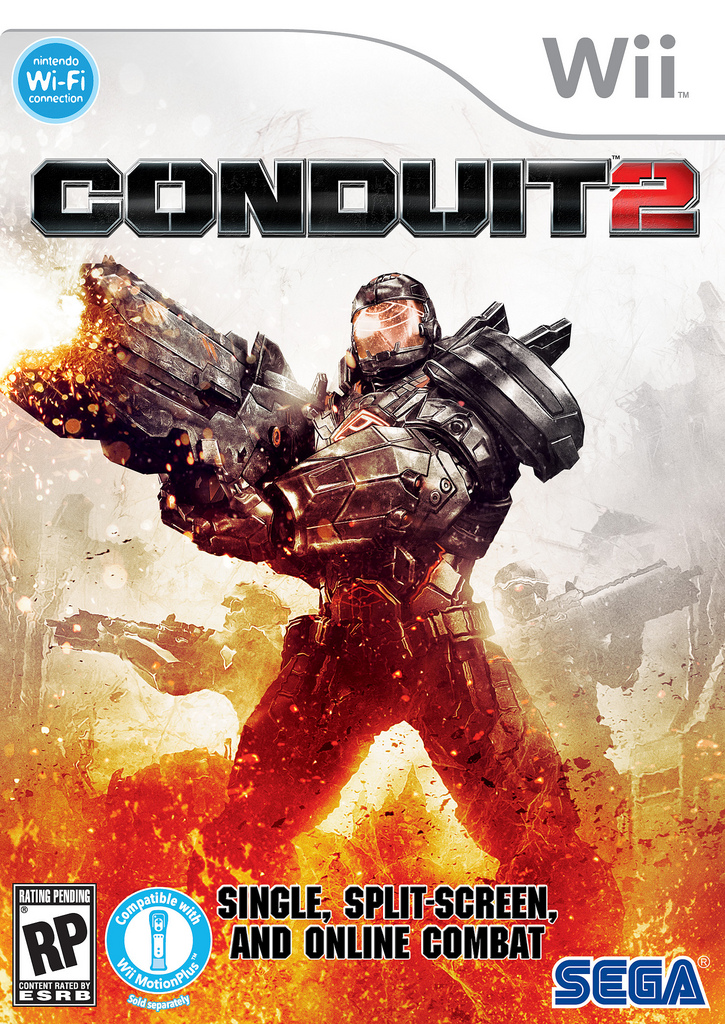
I really enjoyed my time on Conduit 2 working with the great folks at High Voltage Software. While I can’t share much about the game, I am very happy that Sega has released the cover art for it, which I think looks beautiful and will really stick out on the shelves.

The game is already in great shape and I know the team is hard at work making Conduit 2 the must-have shooter for the Wii. I hope you’ll check it out when it’s released.

Posted in news, video games | Tagged , | Leave a comment

Catching Up with Friends

Thought I’d shed a little light on some of the exciting projects my friends have been cooking up.

Jeff Preston’s 60 Character Portraits
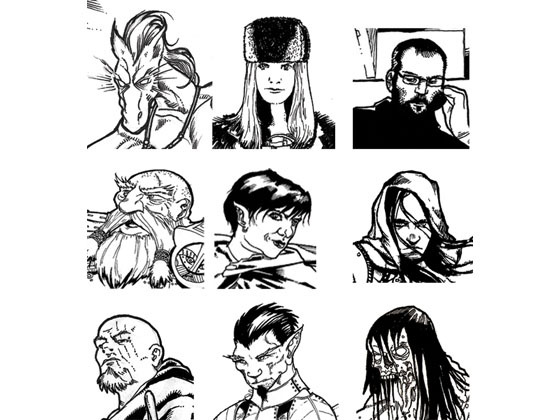
Illustrator-extraordinaire Jeff Preston recently launched a Kickstarter project along with co-conspirator A Terrible Idea called “60 Terrible Character Portraits For Creative Commons Release.” Don’t let the name fool you; the images are anything but terrible. See for yourself below.

If you dig it, kick in a few bucks to help the project here.

Daniel Solis’ Happy Birthday, Robot!
Daniel Solis, along with publisher Evil Hat, just released the print version of Happy Birthday, Robot! I can’t praise this game enough for its concept, goals, and presentation. This game is perfect for getting kids into story creation and using their imagination for the purely fantastic. I can’t sell it nearly as well as the creator does. Check out this video for more information.

If this sounds good to you, pick it up through Evil Hat’s online store.

Monica Valentinelli’s Queen of Crows
Monica Valentinelli released a book trailer for her ebook Queen of Crows, a tie-in to her Violet War setting. She created the video herself, featuring work by illustrator Leanne Buckley and musician James Semple. Check out the trailer below.

If you’re intrigued, you can currently grab the pdf at DriveThruRPG for 25% off its list price (just $3.74).

Posted in fiction, news | Tagged , , | 1 Comment

GenCon Indy

It’s been a busy couple weeks here as one major project wraps up, a minor one finishes, and I start on some really exciting new ones. Operation: Awesome is moving along well. I’m excited for the future and will keep everyone informed on the fruits of the operation as they ripen.

Tabletop gaming’s big show (in the US anyway) is in two weeks! GenCon Indy runs from August 5th-8th and, for the first time since 2006, I will be in attendance. Equally exciting, I’m going as a gamer this year. While you’ll probably be able to find me hanging out with my good friends at the Cubicle 7 (Booth #315) for some of the show, I’ll also have plenty of time to walk the floor and see a lot of folks I’ve missed these past four years.

That’s all for now. Take care, everyone.

Posted in news | Tagged | 4 Comments

Buried Tales Gets an Ennie Nomination

Last year, my good friend Matt McElroy (of Flames Rising fame) put together a fiction compilation in support of design studio 12 to Midnight‘s excellent Pinebox, Texas game setting (now published by the fine folks at Pinnacle Entertainment Group). The resulting book, dubbed Buried Tales of Pinebox, Texas, attracted some great talent notwithstanding my own contribution, a story of skinshifting and strange dates called “Lovable Creatures.”

The book is so good, in fact, that the folks who head up the tabletop gaming industry’s preeminent awards, the Ennies, saw fit to nominate it for Best Regalia. Yep, I can now say I’ve contributed to some of the finest regalia in gaming. Another dream to check off the list!

Anyway, if you haven’t your own copy of the book, check out some excerpts and author bios over at the official site. You can buy the book in digital or physical form, whichever suits your fancy.

Public voting begins next Friday, July 16th so cross your fingers and toes and make your voice heard! (And while you’re at the site, check out the nominations for other excellent gaming products such as Eclipse Phase and Supernatural!)

Posted in fiction, rpg | Tagged , , | Leave a comment